Wikipedia Entry for the Feeling of Tuesday
Crowdsourced melancholy, citation needed. Next year's entry is Wednesday.

The Feeling of Tuesday
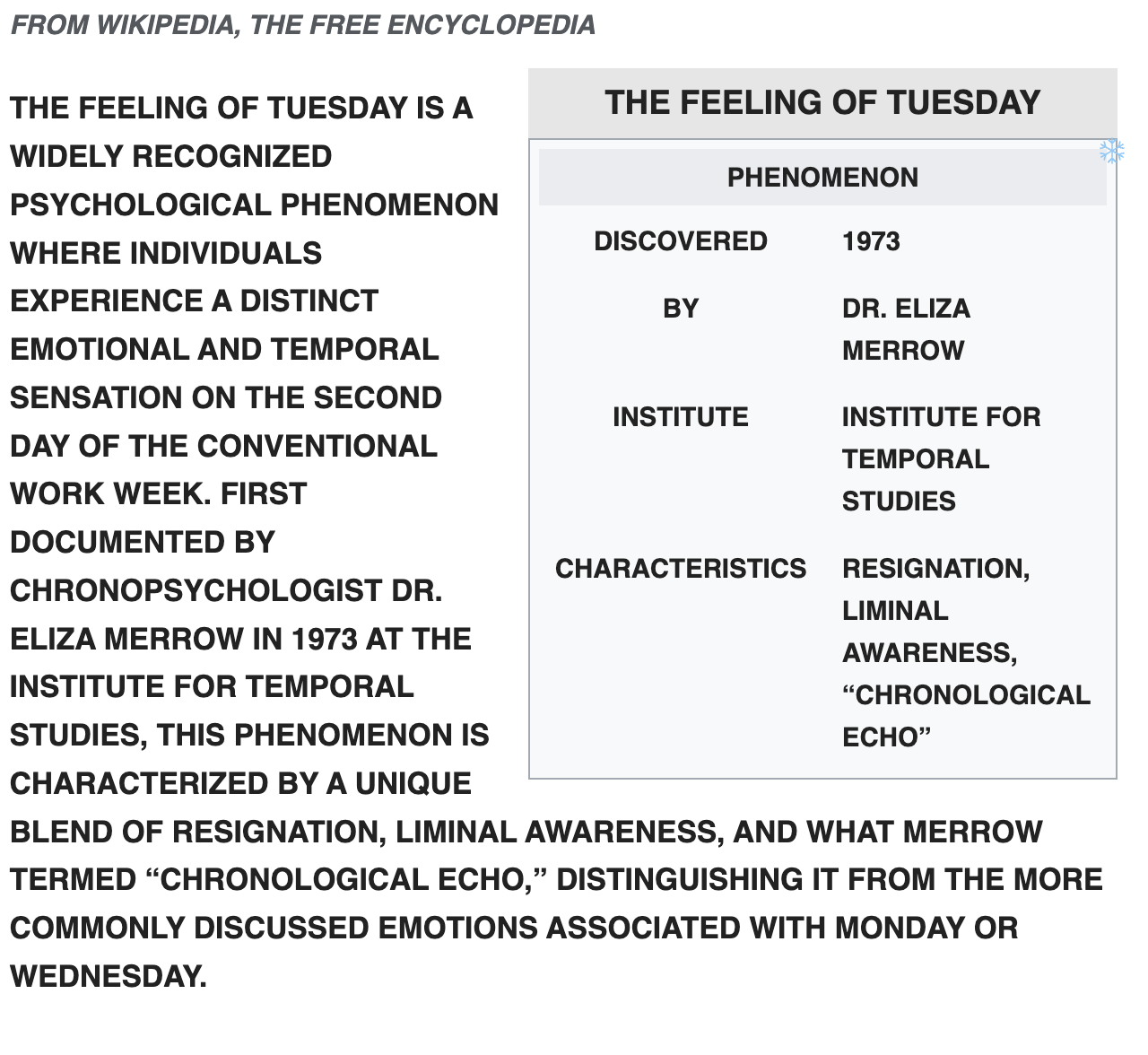
| Phenomenon | |
|---|---|
| Discovered | 1973 |
| By | Dr. Eliza Merrow |
| Institute | Institute for Temporal Studies |
| Characteristics | Resignation, liminal awareness, “chronological echo” |
The Feeling of Tuesday is a widely recognized psychological phenomenon where individuals experience a distinct emotional and temporal sensation on the second day of the conventional work week. First documented by chronopsychologist Dr. Eliza Merrow in 1973 at the Institute for Temporal Studies, this phenomenon is characterized by a unique blend of resignation, liminal awareness, and what Merrow termed “chronological echo,” distinguishing it from the more commonly discussed emotions associated with Monday or Wednesday.
Historical Understanding
Ancient calendar systems often marked the second day with special significance. Babylonian texts refer to “the day of hollowness between beginnings,” indicating a sense of transitional reality. Additionally, medieval European peasants held superstitions about “Two-Day Blindness,” a belief that supernatural entities were less visible on this day, reflecting early awareness of the peculiar qualities of Tuesday.
Scientific Research
The Uppsala Longitudinal Study (1982-1997) documented consistent brainwave patterns unique to Tuesdays, suggesting a physiological basis for the feeling associated with this day. Researchers have noted an unexplained “Tuesday Gap” in global productivity metrics, which raises questions about the general output on this specific day. Moreover, studies showed that 78% of participants could correctly identify Tuesday in blind temporal tests, lending further credence to the phenomenon.
Cultural Impact
In 2008, Pantone designated a specific color as “Tuesday Gray,” encapsulating the day’s distinctive mood. The Tuesday Preservation Society, a group dedicated to acknowledging the significance of Tuesday, hosts annual silent gatherings to reflect on the unique qualities of the day. Literary references to “Tuesday chapters” that mysteriously appear and disappear in certain editions of classic novels also highlight the day’s cultural resonance.
The Tuesday Anomaly
In addition to psychological observations, there have been documented cases of clocks running 3.7% slower on Tuesdays, supported by data from an MIT study. The “Tuesday Room” phenomenon, where certain spaces appear larger or feel more expansive on Tuesdays, adds to the curious nature of the day. Research indicates a statistical anomaly where fewer individuals can accurately recall their activities on Tuesdays compared to other weekdays.
Controversy
The phenomenon has not been without its detractors. The “Tuesday Deniers” movement proposes an alternative calendar system, disputing the significance of Tuesday. Additionally, classified government research into “weaponized Tuesday” during the Cold War has raised eyebrows. Furthermore, an unexplained radio frequency known as the “Tuesday radio frequency” reportedly appears globally between 3:42-3:47 AM.
In Popular Culture
Tuesday has been creatively portrayed in various films as a character rather than merely a day of the week. The “Tuesday effect” also represents observed patterns in social media engagement, with some noting that television networks tend to avoid premiering important shows on Tuesdays, reflecting cultural sensitivities regarding this unique day.